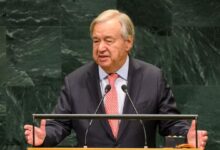
‘No one speaks on behalf of Lebanon’: PM Salam asserts State authority at UN
 Lebanon’s Prime Minister, Nawaf Salam, has stressed that decisions over war and peace, and control of weapons, must rest solely with the State and its constitutional institutions.
He said this priority was reflected in recent Cabinet decisions, taken after Lebanon “found itself facing a war it did not choose, but which was imposed on it.”
Speaking during the annual debate of the UN General Assembly, Mr. Salam said the war broke out “despite our repeated warnings of the dangers of being drawn into it.”
“As the war expanded across the region and initiatives multiplied to end it, we held firm to a principle that admits no compromise: no one speaks on behalf of Lebanon, and no one negotiates for it except the Lebanese State, through its constitutional institutions.”
He rejected any return to Lebanon being used as an arena for others’ conflicts or as a bargaining chip.
“Lebanon’s future is not to be decided on its behalf, and its security and stability must not be the price of deals struck in its absence,” he said.
Ending the war
Lebanon’s position on the war has been clear from the outset, Mr. Salam said: an end to the fighting, a consolidated ceasefire, full Israeli withdrawal from Lebanese territory, the release of all prisoners, and the return of residents to their villages and their reconstruction.
On this basis, he said, the Lebanese State has entered negotiations with Israel, under the auspices of the United States and its President, to reach arrangements aimed at ending the war and restoring full Lebanese sovereignty.
Success, he added, would not be measured by declared intentions but by implementation.
He stressed the need to translate the tripartite framework reached in the negotiations into practical steps, with a clear timetable and a verification mechanism to ensure that all its provisions are carried out.
Avoiding a vacuum after UNIFIL
Mr. Salam praised the UN Interim Force in Lebanon (UNIFIL), including its leadership, personnel and staff, for their courage and sacrifices in maintaining stability, supporting the Lebanese army and implementing Security Council resolution 1701, the 2006 measure designed to end the war between Israel and Hezbollah.
He noted Security Council resolution 2790, which mandates the end of UNIFIL’s operations by the end of this year and the start of its gradual withdrawal, and asks the Secretary-General to explore options for continuing to support implementation of resolution 1701.
Mr. Salam stressed the need to avoid a vacuum should UNIFIL withdraw without agreement on a new international force to take its place and continue monitoring, reporting and liaison work.
Humanitarian toll
The Prime Minister described a war that has caused a widespread humanitarian crisis and extensive destruction of housing, public facilities, infrastructure and productive sectors, leaving large numbers of Lebanese without homes or livelihoods.
He thanked UN agencies and international partners for their humanitarian support and called for continued funding to meet the basic needs of those affected, particularly the displaced, alongside support for early recovery, reconstruction and development.
Lebanon is fulfilling its own responsibilities on reform and extending State authority across its territory, he said, but the international community must also shoulder its responsibilities in upholding Lebanon’s sovereignty and implementing resolutions of international legitimacy.