Escalating fighting in Yemen deepens food security crisis
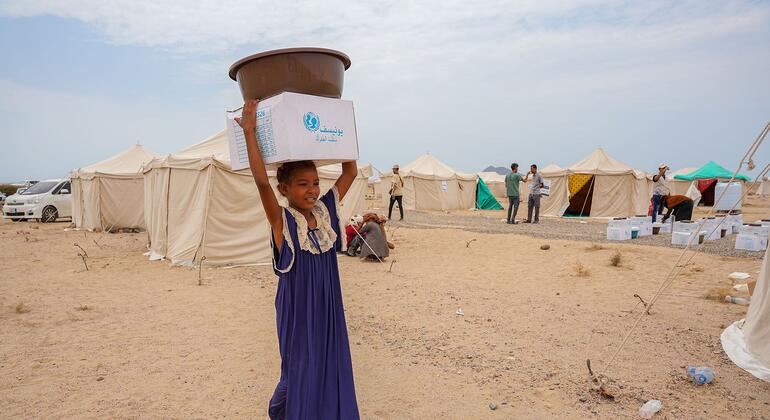 Renewed conflict in Yemen has triggered a surge in hunger that could have consequences in the wider region and beyond, the World Food Programme (WFP) warned on Friday.
Fighting between Government forces and Houthi rebels along the southwestern coast has forced nearly 150,000 people from their homes, disrupted markets and restricted humanitarian access.
“What is beginning as a hunger crisis in Yemen could certainly compound a greater food security crisis far beyond its borders,” Matthew Hollingworth, WFP Assistant Executive Director for Programme Operations, told journalists in Geneva.
Families going hungry
Yemen was already among the world’s top humanitarian crises and “hunger hotspots” prior to the escalation. More than 18 million people nationwide face acute food security, and some 2.2 million children under five are acutely malnourished.
Tweet URL
Speaking from Rome. Mr. Hollingworth said that today, nearly three out of four households in accessible areas are unable to meet their basic needs – “a record number for this year in just a few weeks.”
“People are finding it hard to put any food on the table, or if they indeed have a table if they’re displaced,” he said.
“They’re skipping meals, they are eating a much smaller diversity of food types, and they are facing hunger on a daily basis.”
Food prices are rising sharply, while traders report limited wheat flour stocks and disruption to vegetable oil supplies, which is making it difficult for families to afford these items.
Meanwhile, the influx of displaced people is putting pressure on urban areas and existing displacement sites. Many have arrived at these locations after walking for days without water or food.
Scaling up support
WFP is stepping up operations in Yemen and has assisted more than 70,000 people across two of the biggest “displacement hotspots” in Lahaj and Taiz, providing hot meals and other assistance.
The UN agency was already supporting more than 1.5 million people in Government-held areas prior to the escalation.
“We know we can reach that height of support with the pre-positioned stocks we have, but we are finding it increasingly hard to move food into frontline areas,” Mr. Hollingworth said.
The fighting has cut off access to parts of Taiz and Hudaydah, preventing WFP and partners from accessing some 350,000 people in areas where they used to assist.
Humanitarian teams cannot work in these areas, which are under the control of the Houthi de facto authorities, in line with an operational pause mandated by the UN Secretary-General.
Limited resources, bleak outlook
In the face of the food security crisis, WFP is drawing on its stocks already allocated for the broader response in Yemen.
“We’re robbing Peter to feed Paul,” Mr. Hollingworth said, stressing the critical need for funding to support both newly displaced people and the millions who have depended on the agency’s support for years.
“If the world doesn’t step up soon to help Yemen, the outlook is going to get bleaker,” he warned, because “the consequences of this conflict are stretching beyond Yemen.”
At least 3,700 Yemenis have crossed the Bab al-Mandab Strait to seek shelter in Djibouti, where WFP is working with the authorities to support the arrivals.
Maritime corridors under pressure
Mr. Hollingworth said the Strait is critical for the transport of food, fuel and commercial goods moving between Asia, the Middle East, Africa and Europe.
“Instability around this corridor risks driving food prices higher and deepening food insecurity across a much bigger region –the world.”
He noted that the Yemen crisis is happening at a time when Bab al-Mandab and two other “critical maritime choke points” – the Black Sea and the Strait of Hormuz — are under pressure.
“When all three of these are under pressure at the same time, you can add to that the impact of a super El Niño weather pattern. These consequences are going to ripple through food systems everywhere,” he said.
“We’ve said this before but let me be clear once again: today’s humanitarian shock and supply chain disruptions can become tomorrow’s global food crisis.”