Equality ‘ends at the doors of the Security Council’, Kenya’s Ruto tells General Assembly
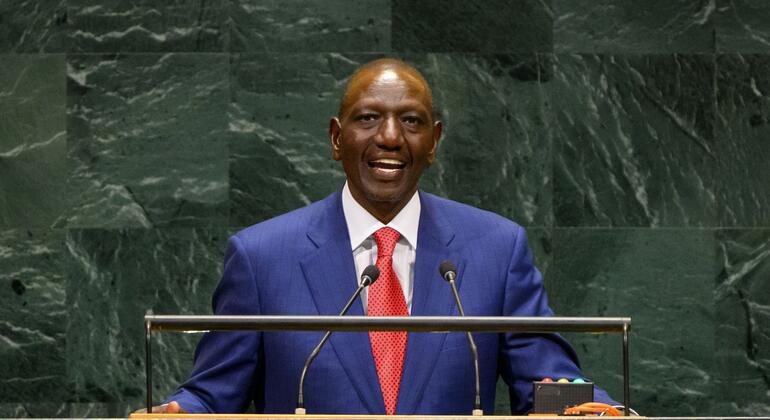 Kenyan President William Ruto told the General Assembly on Wednesday that the sovereign equality the UN proclaims is contradicted by its own structures, urging Member States to reform the Security Council and an international financial system “built for another age”.
Addressing the General Debate, Mr. Ruto said Kenya spoke “not from despair in this institution, but from conviction in its possibilities”, adding that “multilateralism works when nations summon the will to make it work”.
However, he said the world recorded 65 State-based armed conflicts last year, 13 of them full-blown wars, with nearly a quarter of a million people killed in organised violence and disputes increasingly “frozen, deferred or decided by force”.
‘Permanently excluded’
Every nation has one vote, Mr. Ruto said, yet five hold a permanent power on questions of war and peace that the other 188 do not: “The equality proclaimed in this assembly ends at the doors of the Security Council.”
Africa’s 54 Member States, more than a quarter of the assembly, have no permanent seat on the Council, he said: “Permanently discussed, yet permanently excluded.”
He warned that confidence in the consistent application of international law was weakening in parts of the world.
“International law cannot be invoked loudly in one crisis, cautiously in another crisis, and disregarded when convenient,” he said.
Seventeen years after intergovernmental negotiations on council reform began, he said, “we should not accept that reform is impossible because it is difficult.”
‘Capital must not price prejudice’
Turning to finance, Mr. Ruto said global public debt reached a record $102 trillion in 2024, and 46 developing countries now spend more on interest than on classrooms and medicine.
“The hospital competes with a creditor. The classroom competes with debt service,” he said.
Citing a UN Development Programme (UNDP) estimate that subjectivity in credit ratings has cost African countries some $75 billion, he said developing countries borrow at rates two to four times higher than developed ones. “Capital must price risk. It must not price prejudice.”
“Africa does not come to plead. We come with a proposal,” he said, pointing to the continent’s minerals, renewable energy and youthful population – and Kenya’s planned $16 billion refinery in the coastal city of Lamu, capable of producing 700,000 barrels of oil a day.
“This is not a plea for special treatment. It is a proposition for shared prosperity,” he said, emphasising that a more industrialised, food-secure, better-connected and self-financing Africa can be a stronger partner to the world.
He closed by calling for “not a United Nations of some nations”, but one “where every nation has a voice, every people have a stake and every child has a future”.