Rotting food waste emits 5 times more greenhouse gases than planes
 Rotting food waste is causing up to 10 per cent of total global greenhouse gas emissions – five times more than the entire aviation sector, the UN’s environment agency warned this week.
If overlooked, food waste represents a key driver of the climate crisis, according the UN Environment Programme (UNEP), but tools are already being deployed to tackle that threat, from black soldier flies to empowering waste pickers across the world.
Kitchen table woes
Food waste encompasses everything from unfinished meals to spoiled crops (that’s food that is lost after harvest and before reaching stores).
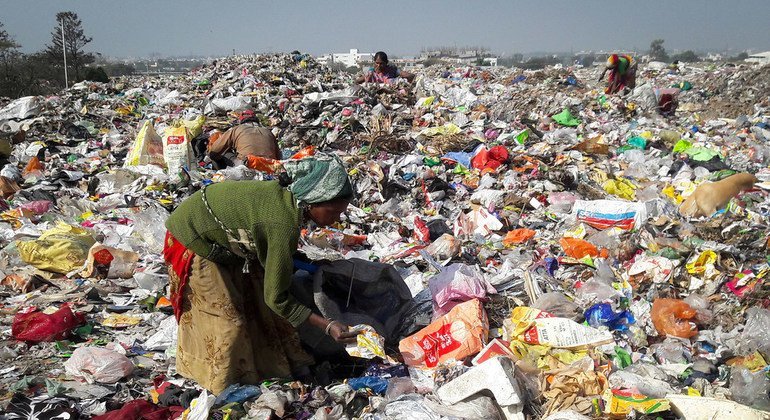
The most polluting form of waste from the kitchen table however is the rotting food which ends up in landfills.
When organic matter such as uneaten food is buried in landfills and deprived of oxygen, it interacts with micro-organisms to produce methane.
Driving methane emissions
Greenhouse gas, which is currently responsible for nearly one third of global warming, is particularly polluting. It traps 86 times more heat than carbon dioxide over a 20-year period, the UN warns.
Importantly, this decomposing food is one of the main drivers of methane emissions worldwide.
In the United States, for instance, municipal solid waste landfills are the third largest source of human-related methane emissions.

© Unsplash/Simon Peel
Food loss and waste represent a major climate and environmental threat.
‘Mountain’ of discarded food
The issue is inherently tied to the very large amount of food waste continuously produced around the world.
Every day, more than one billion meals are left uneaten according to a UNEP report, with 60 per cent of this “mountain of discarded food” coming from households.
This means that resources used to produce this uneaten food are also wasted. The UN’s Food and Agriculture Organization (FAO) estimates that 1.4 billion hectares of land, or around 28 per cent of the world’s agricultural land, is used to produce food that is never eaten, while the water used to grow and prepare that food is also wasted.
As agricultural expansion remains a leading root of deforestation, food waste is thus also contributing to unnecessarily cutting down trees that can no longer pull carbon dioxide out of the atmosphere.
‘We have to move faster’
At the same time, methane, which rotting food waste emits, is short-lived: it breaks down much faster in the atmosphere than carbon dioxide.
This means that cutting methane emissions today can produce climate benefits within decades.
“At a time when the world is searching for practical ways to slow warming quickly, tackling food waste may be one of the most immediate and cost-effective climate solutions available,” underscored Martin Krause, a UNEP official.
Yet, FAO warns that despite international commitments, there has been no tangible progress in reducing food losses since 2015, and the world remains far from achieving the Sustainable Development Goal target of halving per capita global food waste by 2030.
“We have to move faster,” stressed UNEP’s Mr. Krause.
Waste pickers and black soldier flies
Aside from cleaning your plate, effective methane-reduction tools are being deployed around the world.
Eleven governments in Africa committed to reducing methane emissions by incorporating waste pickers into formal waste management systems, training them on how to sort and compost organic waste. With funding from the UNEP-convened Climate and Clean Air Coalition, these initiatives have improved the livelihoods of waste pickers, raised awareness of waste separation and led to creating community composting sites.
An alternative to composting, black soldier flies bred by specialised facilities around the world are being used to recycle organic material. From Malawi to Uganda, these helpful insects are already part of waste management systems in a growing number of villages and cities.