

‘Safeguard the postwar order,’ China tells UN General Assembly
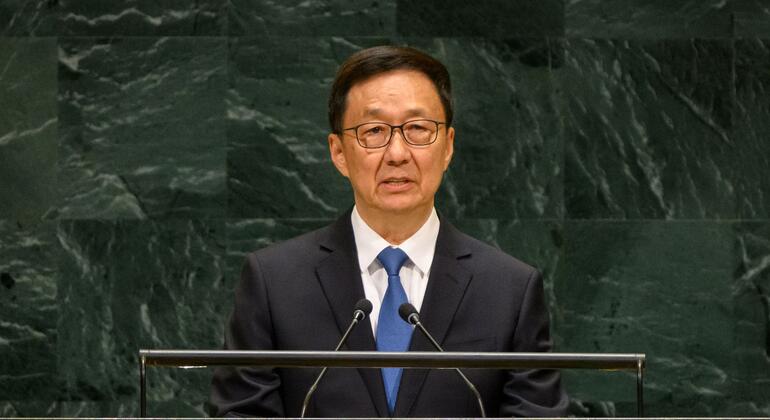 China’s Vice President, Han Zheng, urged the world to defend the postwar international order on Saturday, telling the UN General Assembly that geopolitical conflicts, widening development gaps and mounting global challenges make multilateralism more urgent than ever.
“The world wants peace not war,” Mr. Han told the General Debate of the Assembly’s 81st session.
He said the international system centered on the UN and the international order, underpinned by international law that emerged after World War Two “must be upheld,” calling for disputes to be settled through dialogue rather than “unilateral military actions that violate the UN Charter and circumvent Security Council authorization.”
With power comes responsibility
“Major countries shoulder special responsibilities for safeguarding international peace and security, and they should take the lead in complying with the rules, upholding the rule of law and doing what’s right,” he said.
On the Middle East, Mr. Han said the sovereignty of regional States, including in the Gulf, should be respected, and called for reconstruction in Gaza to proceed “in accordance with the principle of the Palestinians governing Palestine,” alongside a return to the two-state solution.
On Ukraine, he pointed to “four points” put forward by President Xi Jinping as “the fundamental guidance for China in playing a continued constructive role in its own way for achieving a political settlement of the crisis.” He also called for an immediate end to the blockade and sanctions against Cuba.
Turning to development, Mr. Han called for a global partnership “based on unity and equality, and that is balanced and inclusive,” with priority given to poverty reduction, food security and energy transition. Developed countries, he said, should honour their financing and climate finance commitments.
‘People-centred’ AI
On artificial intelligence, he said the world “should take a people centered approach and develop AI for the positive and for good, narrow the digital divide and promote development that is universally beneficial.”
He added that “protectionism produces no winners,” calling for the World Trade Organization (WTO)-centred system to be defended.
On cultural exchange, Mr. Han said “diversity has created splendor in the world,” and that “condescension and the self-centered mindset have no place in the interactions among different cultures.”
Reaffirming support for the UN, he said: “Multilateralism is a choice made by humanity after going through scourges, and fairness and justice are the joint pursuit of the people of all countries.”
Amplify voice of the ‘Global South’
China backs UN reform, he said, but wants it to strengthen – not merely cut – the organization’s bodies and mandates, while boosting the voice of the Global South.
He also praised outgoing Secretary-General António Guterres who leaves office at the end of 2026 and said China wants his successor to be someone who “honors the UN Charter, has exceptional capability, upholds integrity and fairness, and demonstrates courage and dedication.”
Mr. Han marked 55 years since General Assembly resolution 2758, adopted on 25 October 1971, which recognized the Government of the People’s Republic of China as China’s sole legitimate representative at the UN.
Since then, he said, China has been “a stabilizing force in times of volatility,” with the best record on peace and security among major powers and having made the largest contribution to peacekeeping operations of any permanent Security Council member.
He said China has driven around 30 per cent of global growth in recent years, mobilized more than $23 billion under the Global Development Initiative, and granted zero-tariff access to all African countries and least developed countries with which it has ties.
“China will join hands with all other countries to build a community with a shared future for humanity and make the world a better place for all of us,” Mr. Han said.


