Canada urges stronger partnerships as global order faces ‘rupture’
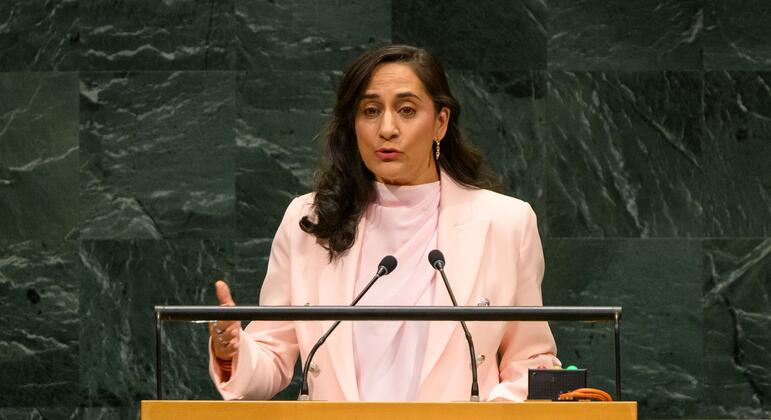 Canada’s Foreign Minister Anita Anand warned the UN General Assembly on Saturday that the international order has entered an era of profound disruption, calling for stronger multilateral cooperation and new partnerships as major powers increasingly turn away from global economic integration.
Drawing on her upbringing in the coastal province of Nova Scotia, Ms. Anand opened with a maritime metaphor: “The tide does not wait. You must move with it.”
“The tide has turned in the global order,” she said, describing the upheaval as a “rupture, not a transition”.
She argued that great powers were retreating from economic cooperation, while State sovereignty, a cornerstone of the UN Charter, was too often treated “with disdain”.
Against that backdrop, Canada would pursue greater “strategic autonomy”, reducing over-reliance on any single partner while diversifying economic and diplomatic relationships.
Coalitions in an age of disorder
Ms. Anand said Canada would build issue-based coalitions of small States, middle powers and major powers to address common challenges, highlighting cooperation in support of Ukraine and security in the Arctic.
At the same time, she stressed that such partnerships should reinforce rather than replace the multilateral system.
Canada and partners had launched a “Partners for Multilateralism” initiative aimed at supporting reform of the UN and other international institutions to make them “more representative, more effective and more trustworthy”, she said.
Canada would also pursue what she called “values-based realism”, strengthening strategic capabilities in emerging technologies, critical minerals, defence production and energy.
Its efforts to diversify trade included stronger relationships in the Indo-Pacific, Gulf region, Latin America, Africa and Europe, as well as renewed partnerships with India and China.
Security from Ukraine to the Middle East
Turning to international security, Ms. Anand reaffirmed Canada’s support for Ukraine and a “comprehensive, just and lasting peace” based on the country’s sovereignty and territorial integrity.
She also described the Arctic as central to Canadian identity and security, highlighting cooperation with Indigenous peoples and regional partners.
On Iran, Ms. Anand said Canada regarded the country as the “principal threat to peace and security in its region”, condemned attacks she attributed to Tehran and said Iran “must never acquire a nuclear weapon”.
Addressing the Israeli-Palestinian conflict, she said self-determination was a right belonging to both peoples.
“Israel’s right to exist is not up for debate, and the right of the Palestinian people to self-determination in a state of their own is also not up for debate,” she said.
Canada remained committed to a negotiated two-State solution, she added, while maintaining that Hamas could have no role in governing Palestine and describing Israeli settlements in the West Bank as illegal under international law.
‘Move with confidence’
Elsewhere, Ms. Anand highlighted support for security and elections in Haiti, humanitarian assistance for crises including Sudan and Gaza, and international cooperation on responsible artificial intelligence and maritime security.
Returning to her opening metaphor, the Foreign Minister said Canada could respond to the changing international landscape with nostalgia or despair, but “that’s not an option”.
Instead, she said the country would “move with confidence and strength”, remaining committed to long-term partnerships, international law and the principles of the United Nations.
“This is the path that Canada will take,” she concluded, “and we invite you to join us in partnership.”